
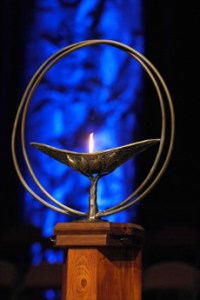
Grateful for the religious pluralism which enriches and enables our faith, we are inspired to deepen our understanding and expand our vision. As free congregations we enter into this covenant, promising to one another our mutual trust and support.*
Our living tradition draws upon the wisdom and teachings of religions and human experience around the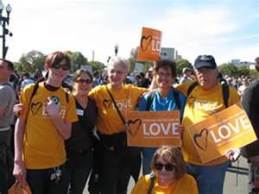 globe and throughout history. We seek to liberate minds to search for truth and pursue deeper understanding of our world and our place in the universe. Our Unitarian Universalist principles call us to act in ways that transform lives and ultimately our world for the better. We stand boldly on the side of love and justice, breaking through barriers of oppression and intolerance. Our vision of a world community with peace, liberty and justice for all is an expansive and worthy pursuit.
As Unitarian Universalists, we dedicate ourselves to one another, to promise our mutual trust and support in, among, and beyond our congregations. It takes a high level of commitment of money, time, and leadership to realize our vision and sustain our ministries and programs. One significant way we support the vitality of our faith community is through our gifts of money. Sharing of our resources is part of our shared ministry in the Beloved Community we create together.
In community, money flows from and through our interconnected relationships, rich with complexity, attitudes, and energy; and at its best, money is dynamic, empowering , and generative–an instrument of transformation. We do not have to possess a great amount of money to use what we have in ways that are beneficial and life-sustaining. Abundance is realized when we appreciate all that comes into our lives and share what we can with intention and good will. We are blessed and so we are called to be a blessing to the those around us and to the world.
Giving and generosity are matters of the spirit and at the heart of stewardship. Giving is a spiritual discipline, a practice that reflects one’s religious values, spiritual depth, and maturity. Being generous is a way to help take care of others and a way to say thank you to God and the Universe for everything we are given.
There is a direct relationship between one’s deepest held values and the motivation to give. We contribute our time and resources to the things that matter most to us and for which we are grateful. Therefore, our money and our giving have greater impact when we are intentional about how we express our gratitude and live out our values.
How we share what we have as people of faith matters.
We might ask ourselves…
- Have I taken time to experience gratitude for all I have received in my life and from my faith community?
- In what ways am I expressing gratitude and acting upon my deepest held values and beliefs?
- Am I giving to my faith community as generously as possible within my means?

During this Holiday Season, may each of us be an instrument of Love and Illumination, Hope and Generosity~

_______________________
Looking for meaningful ways to support UU values? In addition to your local congregation, here are some organizations in your wider UU Community to consider in your year-end giving….
Church of the Larger Fellowship (CLF)–a virtual and global UU congregation. http://www.clfuu.org/
Faithify–a UU crowdfunding website: http://www.faithify.org/
Unitarian Universalist Association–: http://www.uua.org/giving
UU Partner Church Council–connecting UUs and congregations around the world: http://www.uupcc.org/
UU Service Committee social justice and human rights organization: http://www.uusc.org/
* Excerpt of the Unitarian Universalist Association’s covenant to affirm and promote its principles. http://www.uua.org





 givingspeaks.com